

Today I want to talk about fish, mercury, and the degree to which we need to be concerned about mercury exposure.
For once, the government and environmental agencies have done a great job at alerting us to risk of exposure for toxicity that allows us to take action. It has been common knowledge for many years now that mercury accumulation from environmental pollution is accumulating in seafood and increasing our risk of exposure when we eat these species. I don’t know whether it is the game of telephone at play or the pervasiveness of this message that has led to many avoiding seafood altogether, but this is also becoming commonplace and I think it’s a huge problem.
Seafood is chock full of amazing nutrients that are challenging to get elsewhere, unless you are a fan of organ meats. Organ meats are a pretty hard sell for most, which leaves seafood as a more palatable source to get trace minerals such as zinc, selenium, iron, some B vitamins, magnesium and copper. And, unlike organ meats, seafood can also be a great source of omega-3 fatty acids, iodine, Vitamin D, and even calcium if you eat canned fish with the bones in, such as sardines. Which seafood sources contain which nutrients varies, and so consuming a variety of seafood is always a great idea. While most of these nutrients can be found elsewhere, it usually takes a higher serving of that food to do so and other foods tend not to have so high a quantity of so many minerals. Seafood is, effectively, a super efficient way to ensure you get adequate nutrition.
Fish consumption is repeatedly reported to be the most common exposure to mercury. And this makes sense; avid seafood consumers eat fish weekly and those who aren’t huge seafood consumers will still probably have a serving multiple times a year. More people eat seafood with some regularity than there are dental practitioners removing silver fillings, so yes, on a number by number basis, this makes sense to me.
However, exposure to how much and how often is also part of this equation. We also need to take into consideration what your body does when exposed, and this is where you have more power than you think.
Several things can be done to minimize mercury exposure from seafood, and it’s not as scary as we’ve been led to believe.
Before I dive into what to do, it’s important to understand more about mercury and other heavy metals so that you can better understand the risk-benefit analysis of seafood consumption for yourself.
Mercury, cadmium, lead, iron, zinc, copper are among many metallic minerals found in the earth. If you think back to the periodic table of elements from high school science class, you might remember seeing these all in that chart that was on the wall in your science class. Some of these minerals are essential to our health and others, including mercury, can be toxic.
Minerals and heavy metals are absorbed in the body through similar means, and they interact with one another, and this is where the nuance and the magic lies in being able to empower yourself to reduce toxicity from heavy metals.
Our essential minerals bind to the same transporters as heavy metals do. I think of transporters as the ticket a nutrient takes to get into a night club, and in this analogy the night club is a cell. So an essential mineral like selenium uses the same transporter to enter the cell as mercury does. Once in the cell, the party begins. But both heavy metals and essential minerals effectively get to enter the night club using the same ticket. When you have higher doses of essential minerals, such as iron, zinc, selenium and copper trying to get into the night club, heavy metals such as cadmium and mercury can’t gain access. Conversely, a diet low in minerals, which most of the population is consuming, is akin to a slow night at the club, so mercury and other heavy metals can gain access without trouble at all.
Several studies show a diet low in essential minerals such as zinc, iron, calcium, and other trace minerals led to increased absorption of toxic metals into the cell. If these heavy metals get into the cell, they can change the nucleus of that cell which alters DNA and RNA, leading to changes in the genes which impact chronic disease, such as diabetes, Alzheimer’s heart disease and more. Our essential minerals effectively compete with toxic metals to gain access to the cell, so we want to make sure we are consuming a diet high in minerals. If you are nutrient depleted – low in zinc, iron, selenium, and other trace minerals – your ability to protect yourself from all heavy metals (lead, cadmium, mercury, etc) is inhibited.
That isn’t all these minerals do. Minerals also can bind to heavy metals, support the creation of enzymes which detoxify heavy metals, and facilitate the excretion of them from the body. Many also play arole in reducing the oxidative stress, or cellular damage, caused by heavy metals.
When it comes to mercury in seafood, we find that mercury competes with selenium for absorption into the cell. But guess what?? A lot of seafood is naturally high in selenium, so this will act as a buffer against absorption!
Selenium also plays a significant role in detoxifying mercury. In marine environments, selenium reacts with mercury to form mercury (II) selenide, a highly insoluble compound that reduces mercury’s bioavailability and toxicity.
The other consideration is that not all seafood is created equal. Large tuna and swordfish species accumulate the most mercury as they are older predatory fish. Smaller species accumulate less. Salmon, sardines, trout, and so on can safely be part of a regular diet. But – I will tell you – what I see clinically leads me to emphatically suggest no one avoid seafood unless they are allergic. It is truly a miracle food at protecting the heart and brain and immune system and supporting liver function. It is chock full of so many minerals most of us desperately need. I repeatedly see dramatic, positive changes in clients and patients who incorporate cold water fish into their diet multiple times a week, be it canned, farmed, or fresh.
This chart from the EPA shows which fish species are safest and what you’ll want to avoid.
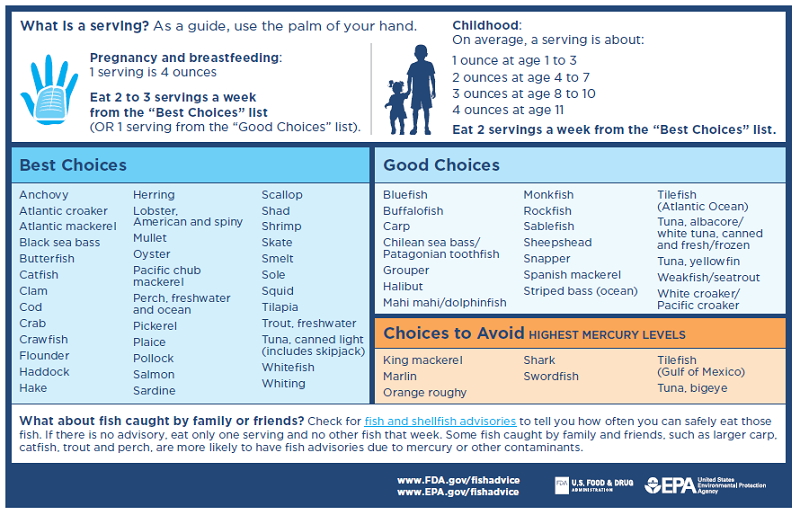
While they suggest eating fish twice a week from the ‘best’ sources, I encourage those I work with who are investing in their heart and brain health to go for 3-4 servings a week; preferably four.
If you want to go a step further, you can choose seafood species which are highest in selenium to offset any mercury. These would be smelt, oysters, mussels, pink salmon, atlantic cod, King salmon, halibut, herring and canned light tuna. Consuming fish with other selenium rich foods, such as brazil nuts, organ meats like liver and kidney, turkey breast, or pork chops can also help, but it also might make for a really weird meal.
Favoring these fish species and foods high in selenium if you do want to enjoy fish is that much more important if you are pregnant, and choosing salmon and herring is going to be even more important for fetal development due to the high omega-3 fats in those species.
Looking at research, I found a couple small studies worth noting. Dietary selenium given to adolescent mice who were exposed to mercury on two separate occasions had reduced accumulation of mercury in the brain, muscle, liver and kidney. Greater excretion of mercury in their feces was seen when selenium was given alongside the mercury at the same time. This is selenium in action, binding to mercury in the intestines of the mice, preventing absorption and allowing elimination. In this paper, the researchers also looked at the RNA of the mice and noted those who were given selenium had reduced changes in proteins and RNA that can lead to problems with Alzheimer’s, immune response, and oxidative stress (cell damage), effectively reducing the toxic effects of mercury exposure on the cell.
When we look for human studies, there aren’t many. I found a couple small interventional studies that support what was observed in the mice.
A very small randomized controlled trial of 23 adults showed that those with low blood levels of selenium who were given supplementation reduced the amount of mercury found in their hair by 34% over 4 months time over the control group who was not given selenium.
Additionally, researchers in China recruited 100 volunteers from a mining and smelting town and gave half of them a selenium supplement. The group given selenium increased excretion via urine by 50% to 250% in just 30 days and continued to increase over the 3 month trial.
Aside from fish, common exposure to mercury comes from silver dental fillings, thermisol from flu vaccines and environmental pollution from burning coal, working with dental amalgams in the dental industry or in gold mining, and living or working near some industrial plants such as coal-fired electrical plants, cement factories, oil and gas combustion, waste combustion, and incineration areas. For most, it is the slow accumulation that leads to toxicity rather than an acute dose all at once.
Signs of mercury toxicity:
Mercury tends to accumulate in the organs, but show up in a variety of ways, such as:
Brain: Anxiety or unease, Mood fluctuations or irritability, Challenges with memory, Cognitive challenges or difficulty in decision-making, Alterations in sight, sound, or verbal communication, insomnia.
Nervous System: Loss of sensation, Shaking or tremors, Unsteadiness or lack of coordination, Weakness in muscles, Numbness in areas like the hands or face, Trouble maintaining posture or walking, Diminished motor function
Additionally, some people experience:
- Feelings of nausea or vomiting
- Breathing challenges
- Chronic loose stools
Testing Mercury Levels
Urine and blood are the best ways to test for mercury. While urine will measure how much you are excreting, red blood cells accumulate mercury and this can be more helpful in assessing how much your body is holding onto. That said, both are used to assess exposure but both have limitations. Hair studies can be used to assess long-term, chronic exposure as well, but these are less frequently used.
Blood levels measure exposure over the last 90 days, urine levels measure current excretion. Hair analysis can look at months worth of exposure, depending upon how long the hair is.
It’s been recommended that assessing long term accumulation is best done through a chelation text, where you take a pill that pulls mercury from the tissues and then do a urine test to see what is excreted. This is not without risk, obviously, and should only be done under the supervision of a physician who specializes in heavy metal exposure.
While it is understandable to be concerned about mercury levels in fish, it is important to always know that our bodies have many mechanisms in place to offset exposure to compounds which are dangerous. When it comes to mercury and other heavy metals, making sure you have sufficient iron, calcium, selenium, and zinc in the diet can strongly support the body’s ability to compete with, bind to and eliminate these heavy metals. Additionally, having a high antioxidant diet rich in lots of produce will support your cells by reducing oxidative stress that leads to cellular damage.
At the end of the day, if you like seafood, I enthusiastically encourage you to consume it regularly. The benefits still outweigh the risks. Choosing high selenium species, consuming other high selenium foods regularly, or even taking a supplement will also reduce the likelihood of accumulating damaging levels of mercury.
If you’ve found today’s episode helpful, the best way to help others receive this information is to share it with others! That demonstrates relevance to the algorithm gods and puts this show in front of others like you looking for more nuance in the conversations around health and nutrition. If you feel someone you know would benefit from this conversation, you can share this episode directly with them or post it on social media.
Resources:
- Bhattacharya, S. (2022). Essential Trace Metals as Countermeasure for Lead Toxicity.. Journal of environmental pathology, toxicology and oncology : official organ of the International Society for Environmental Toxicology and Cancer, 41 2, 61-67 . https://doi.org/10.1615/jenvironpatholtoxicoloncol.2022040132.
- Schwalfenberg, G., & Genuis, S. (2015). Vitamin D, Essential Minerals, and Toxic Elements: Exploring Interactions between Nutrients and Toxicants in Clinical Medicine. The Scientific World Journal, 2015. https://doi.org/10.1155/2015/318595.
- Flores-arce, M. (2007). Proceedings of the International Symposium on Selenium–Mercury Interactions. Biological Trace Element Research, 119, 193-194. https://doi.org/10.1007/s12011-007-8008-4.
- Mellingen, R., Myrmel, L., Rasinger, J., Lie, K., Bernhard, A., Madsen, L., & Nøstbakken, O. (2022). Dietary Selenomethionine Reduce Mercury Tissue Levels and Modulate Methylmercury Induced Proteomic and Transcriptomic Alterations in Hippocampi of Adolescent BALB/c Mice. International Journal of Molecular Sciences, 23. https://doi.org/10.3390/ijms232012242.
- Seppänen, K., Kantola, M., Laatikainen, R., Nyyssönen, K., Valkonen, V., Kaarlöpp, V., & Salonen, J. (2000). Effect of supplementation with organic selenium on mercury status as measured by mercury in pubic hair.. Journal of trace elements in medicine and biology : organ of the Society for Minerals and Trace Elements, 14 2, 84-7 . https://doi.org/10.1016/S0946-672X(00)80035-8.
- Li, Y., Dong, Z., Chen, C., Li, B., Gao, Y., Qu, L., Wang, T., Fu, X., Zhao, Y., & Chai, Z. (2012). Organic selenium supplementation increases mercury excretion and decreases oxidative damage in long-term mercury-exposed residents from Wanshan, China.. Environmental science & technology, 46 20, 11313-8 . https://doi.org/10.1021/es302241v.
https://drhyman.com/blogs/content/my-experience-with-mercury-toxicity
https://www.health.ny.gov/environmental/chemicals/mercury/docs/mercury_you.pdf
